
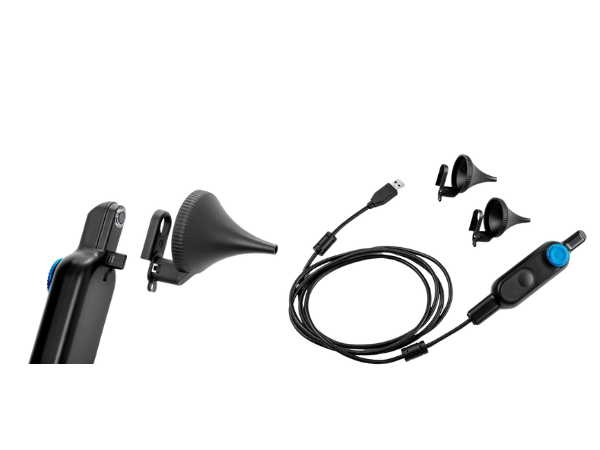
CLIENT: Audelation • PRODUCT: OWL Surgical Digital Otoscope • SERVICE: Medical device contract manufacturing
Meet the OWL
Every year, thousands of patients in the UK are referred for wax removal because their GP, audiologist or nurse practitioner couldn’t deal with it on the spot. The standard otoscope lets a clinician see the diagnosis. It doesn’t give them the ability to fix it.
That’s the gap Audelation set out to close. It was conceived during an era of digital health, when legacy health technologies were being innovated into smartphone solutions such as smartphone otoscopes. The gap was the ability to enhance a new technology to perform concurrently therapeutic procedures digitally.
The OWL is a surgical digital otoscope designed for ENT clinicians. It combines high-quality video examination of the outer ear canal with the facility to carry out procedures: wax removal and foreign body removal, with future capability for injections and grommet procedures. All within one handheld device.
Before the OWL, clinicians had three options. The ear microscope, a large, costly piece of equipment fixed to a room and needs extensive training. Or loupes, specialist magnified glasses that require equal eyesight acuity with practical issues such as deep canal work and eyesight fatigue. Digital otoscopes lacked the facility to perform procedural work. None is practical at the point of care.
The OWL replaces all three. It brings procedure capability to GPs, ENT surgeons, A&E doctors, audiologists and advanced nurse practitioners at a fraction of the cost, in a device they can carry with them.
“We’ve combined the function of an otoscope and the procedural function of loupes into a single device. Our customers really like the fact that we’ve made a two-in-one and made the cost a lot cheaper and better value than buying them individually and also improve the key clinical skill of otoscopy with innovative features.”
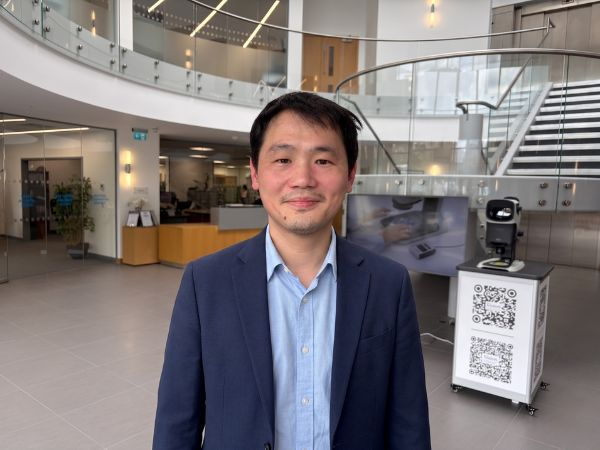
Tsong Kwong, Founder and CEO, Audelation
The clinical case is clear. Wax removal services in the UK are scaling quickly due to lack of provision in General Practice. Those services need technology that works at the point of care, not in a separate clinic. The OWL is built for exactly that.
Audelation is now expanding internationally, with agreements in place for Canada, New Zealand, Australia and the United States.
The manufacturing challenge
Getting the OWL from design to reliable production was not straightforward. The device combines optics, digital imaging and mechanical assembly in a handheld format. That requires a manufacturer comfortable working at a level of precision most contract manufacturers rarely handle.
Audelation’s first manufacturing partner, engaged from around 2022, had strong electronics capability. Building circuit boards was their specialism. But optical and mechanical assembly at scale was clearly out of their comfort zone. Making fine adjustments was difficult. As Audelation approached scale-up, the gap became a problem.
Tsong knew what he needed. An opto-mechanical assembly specialist in the UK, working to medical device standards, with the facility and experience to take on a complex handheld product.
Finding that partner was harder than it sounds.
“Your skills are rare. Especially on the optical side. The number of partners comfortable doing optical work were very small in the United Kingdom.”
How Tsong found Vision Engineering Technology Partnerships
Tsong found Vision Engineering Technology Partnerships through a Google search. The subcontracting page was the entry point, but it was the desktop research into Vision’s background that made the decision clear.
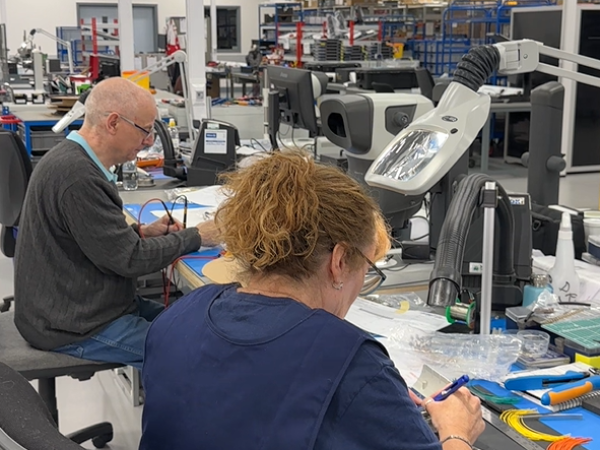
Vision Engineering’s core business is precision microscope manufacturing. Optical assemblies, mechanical precision and regulated production environments are central to what the team does every day. For a product like the OWL, that heritage mattered.
For anyone asking how to find a medical device manufacturer in the UK with genuine optical specialism, Vision Engineering Technology Partnerships’ background is exactly what that search looks like in practice.
Three things sealed the decision.
Regulatory compliance – Vision Engineering holds ISO 13485 certification, the quality management standard required for medical device manufacturing. This certification covers the quality management system (QMS) specific to medical devices, including document control, traceability and risk management. The facility includes cleanroom assembly areas and a large dedicated production space, both indicators of a manufacturer operating consistently to regulatory standards.
“Vision Engineering has ISO 13485, which is crucial. When I looked at your facility, you’ve got cleanroom crucial for optics. That gave me confidence. You’ve got the business to support such a big operation.”
Practical expertise – Vision Engineering’s expertise in manufacturing medical microscopes meant the team already understood optical engineering, fine mechanical work and the kind of problem-solving a complex handheld device demands. The OWL was smaller than a microscope, but the principles were familiar.
“ The level of expertise, that knowledge you bring to the table. You can’t really find that elsewhere.”
UK manufacturing – Working with a new partner often brings a high level of unforeseen engagement, especially when moving from an established one. Being “local” avoided problems like international travel, kept the partner readily available to solve issues in person, and meant native language understanding.
“Manufactured in the UK was a major deciding factor for us; with our first partner there were many unforeseen circumstances that needed addressing in person and the only sensible solution was to manufacture in the UK.”
How the partnership worked in practice
Vision Engineering Technology Partnerships received technical drawings from Audelation’s design agency and worked through the assembly challenges that had slowed the previous manufacturer. A pilot build came first, with both teams learning the product before committing to full production.
That caution paid off. The first full production batch delivered multiple the volume of the original pilot build, with consistent quality across units.
UK proximity was a practical advantage throughout. Tsong could visit the facility, review builds in person and resolve issues quickly. That level of access is significantly harder to maintain with overseas manufacturers, where inspecting production and verifying compliance documentation adds risk.
“Being able to come to you with problems, or you coming to me. It just makes things smoother. If you go abroad, you don’t know the reputation. You’re also worried about the genuineness of any ISO certificates, which isn’t so much of a concern with a UK partner.”
The Vision Engineering Technology Partnerships team also contributed ideas to improve the manufacturing process itself, rather than simply executing against existing drawings. For Tsong, that proactive approach is what a long-term manufacturing relationship looks like. That input reflects design for manufacture (DFM) and design for assembly (DFA) thinking in practice. Rather than flagging problems at the point of production, the team fed back practical, grounded suggestions to make the OWL better to assemble consistently and reliably at scale. For a medical device moving into volume production, that kind of engineering input at the manufacturing stage can prevent costly design revisions later.
“The team knows enough. They’re experts in the field. They know how to improve the product and do it sensibly.”
Results
- Production volume scaled significantly from the original pilot build
- Consistent unit quality maintained across production batches
- Manufacturing process improvements proposed and implemented by the Vision Engineering Technology Partnerships team
- Single point of contact kept communication efficient throughout
- Audelation now expanding into Canada, New Zealand, Australia and the US
What audelation says
“It’s a very promising relationship. It is looking fruitful. We’re building a core for the future. That’s what any medical device company wants. You want a partnership which is reliable. And I think that’s something Vision Engineering Technology Partnerships can do.”
Tsong Kwong, Founder and CEO, Audelation
Vision Engineering Technology Partnerships provides medical device contract manufacturing from its UK facility. The team specialises in precision opto-mechanical assembly for regulated medical devices, operating to ISO 13485 with cleanroom capability. Contact us to discuss your product.

