
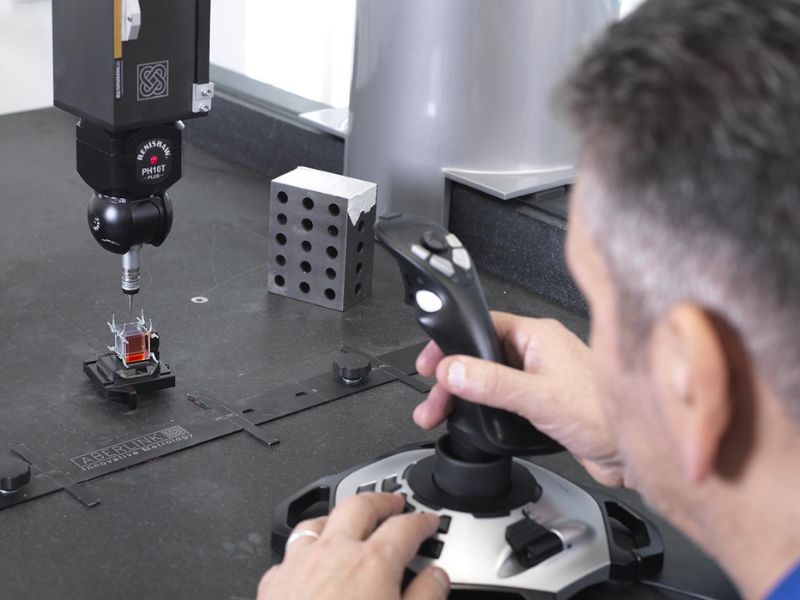
Opto-mechanical assembly is the process of building systems that combine optical components, such as lenses, prisms and sensors, with precision mechanical parts. Think microscopes, surgical imaging devices, metrology instruments and defence optics. The optics do the seeing. The mechanics hold everything in exactly the right place, to tolerances measured in the microns. That last part is where most manufacturers come unstuck.
Why optical systems fail at micron scale
A standard mechanical assembly has some forgiveness built in. If a bracket sits a fraction of a millimetre off, the product usually still works.
Optical systems offer no such forgiveness. A lens misaligned by a few microns produces a blurred image, a distorted measurement or a device that fails inspection. Alignment, centration and focus all depend on the mechanical housing holding optical elements in precise, stable positions, through handling, temperature changes and years of use.
So the work asks more of a manufacturer. Dust on a lens surface is a defect, not a cleaning job, which is why cleanroom assembly areas matter. Optical surfaces and coatings scratch and contaminate easily, so operators need specific training in handling them. And building the unit is only half the job. Many optical assemblies need active alignment during the build, then testing to verify optical performance before they leave the bench.
From optical design to opto-mechanical design
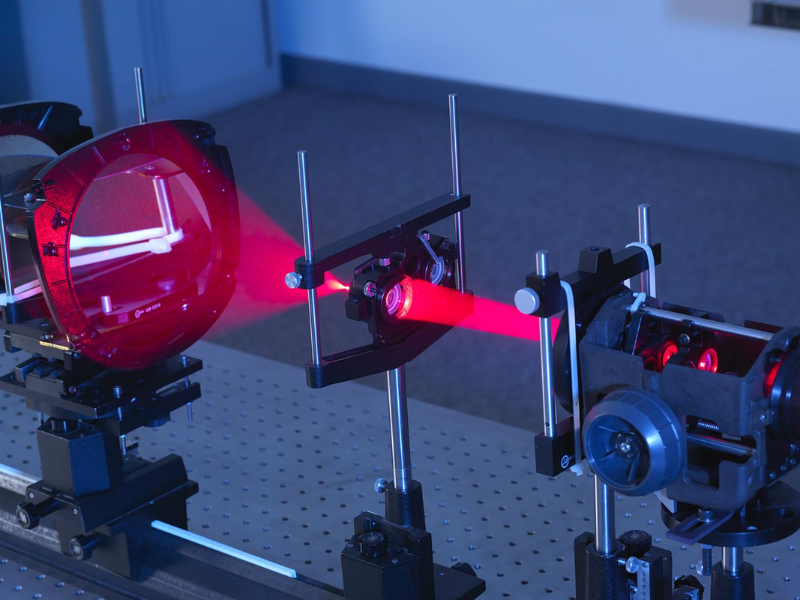
Optical design sets the specifications: lens curvature, coatings, and where each element sits along the optical axis. Opto-mechanical design works out how mechanical structures hold those optical elements to specification. Lens mounts and retaining rings hold each element exactly where the design says. Flexures and spacers handle the fine positioning and keep stress off the glass. A poorly mounted lens introduces optical aberrations before the product ever reaches a customer.
Material selection matters more than in general engineering. Metals like aluminium and titanium are common choices. Engineers pick them for how their thermal expansion behaves alongside glass. Get this wrong and a unit that performs at room temperature drifts out of alignment in the field. Good opto-mechanical design balances mechanical stability against optical performance in the conditions the product will actually face, not just in the lab. The design has to hold through vibration in transit and extreme temperatures in use.
Simulation tools help here, analysing tolerances and thermal effects before anyone cuts metal. The output is a complete design package: part and assembly drawings a production team can build from again and again. This is work we take on directly. When a client’s lens designer sets demanding specifications, our engineers work alongside them to make the design buildable. And if the mechanical design isn’t finished, we can finish it.
A recent example
A client came to us with a handheld medical device. It combines digital imaging, optical components and fine mechanical assembly in a single compact unit.
Their first manufacturing partner was strong on electronics. Circuit boards were their specialism, and that part of the build went well. The optical and mechanical assembly was a different story. Fine adjustments were difficult. As the client approached scale-up, the gap turned into a real problem.
Their search for a replacement revealed something they hadn’t expected. Very few UK manufacturers are comfortable doing optical work at all. Electronics specialists are everywhere. Optical specialists are rare.
Pilot first, then scale
When that client moved their production to us, we started small. Before committing to volume, both teams built a pilot batch and learned the product together. Both teams refined assembly sequences. Problem areas surfaced early, while they were still cheap to fix.
During the pilot, our engineers also fed suggestions back to the client to make the device easier to assemble consistently at scale. This is design for manufacture (DFM) and design for assembly (DFA) thinking applied to optics. Our DFA approach simplifies components so the product becomes cheaper and faster to assemble, at any volume. For a regulated device heading into volume production, that input prevents costly design revisions later.
The first full production batch delivered several times the pilot volume, with the same quality across every unit. The client put it simply: the team knows how to improve the product and do it sensibly.

68 years of opto-mechanical systems
Vision Engineering has manufactured precision microscopes since 1958. Optical alignment and fine mechanical work are our core business, not a side quest, and the skills come from decades of building instruments, not from a quality handbook. When clients bring us a device smaller or stranger than a microscope, the principles are familiar.
For regulated sectors, that background pairs with the certifications buyers need. Our facility operates to ISO 13485 for medical devices, with cleanroom assembly areas and full traceability. Defence clients work with us under JOSCAR registration to the same precision standards.
Do you need a specialist?
A few signs that your product needs an opto-mechanical assembly specialist rather than a general contract manufacturer:
- It contains lenses, prisms, sensors or other optical components
- Image quality, measurement accuracy or beam alignment defines product performance
- A general manufacturer has already struggled with the optical parts of your build
- You’re heading into a regulated market where consistency and traceability are non-negotiable
If any of these sound familiar, a general manufacturer will likely cost you time, quality or both.
Talk to us about your optical build
Vision Engineering Technology Partnerships provides opto-mechanical design and assembly from our UK facility, from prototyping and pilot builds through to volume production. We work to ISO 13485 with cleanroom capability, and our engineers contribute DFM input from the first build onwards.
If your product combines optics and precision mechanics, contact us to discuss it. Bring your drawings, or bring the problem your current manufacturer can’t solve.

